

The Check My Ads Institute welcomes Ofcom’s decision to solicit input from the public, including civil society organisations, about the information that internet service providers should disclose in their transparency reports, as required by Schedule 8 of the Online Safety Act (OSA). We believe it is important to discuss transparency requirements, including those related to the platform’s incentive structures that promote and generate illegal harms online.
Platform Business Models Can Not Continue to Be Opaque
To ensure that OSA has a meaningful impact and protects vulnerable Britons online, we believe that internet services, especially regulated user-to-user platforms (U2U) that host regulated user-generated content (UGC), must report the business models they rely on to monetise their services.
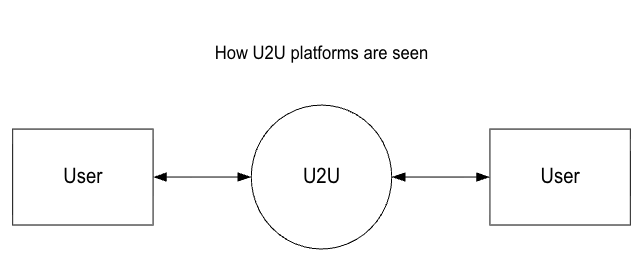
A naive view of U2U platforms is that they facilitate interaction between two equal end-users. In reality, at least four entities are part of the exchange that, through digital advertising, drives revenue generation on platforms: (1) the U2U platforms themselves, (2) UGC creators and news publisher content,1 (3) end-users, and (4) advertisers.
Platforms generate revenue through a variety of business models, which include decisions about how funds are acquired (e.g., advertising, subscriptions) and how they are distributed among creators. For example, platforms can generate revenue by providing a digital auction ecosystem in which UGC creators and news publisher content can host advertising space on their content for a fee, and advertisers can bid on and purchase it. This allows U2U platforms to take a cut of these brokered agreements between these two parties. Once an auction transaction is complete, the publishing creator receives a percentage of the advertiser’s final paid bid price for ad space on or adjacent to the posted content. On many platforms, such as YouTube,2 this content is where ads are placed.
Alternatively, depending on content monetisation policies, U2U platforms may take the entire payment from an advertisement and then distribute their own revenue to content creators based on metrics they unilaterally choose.3
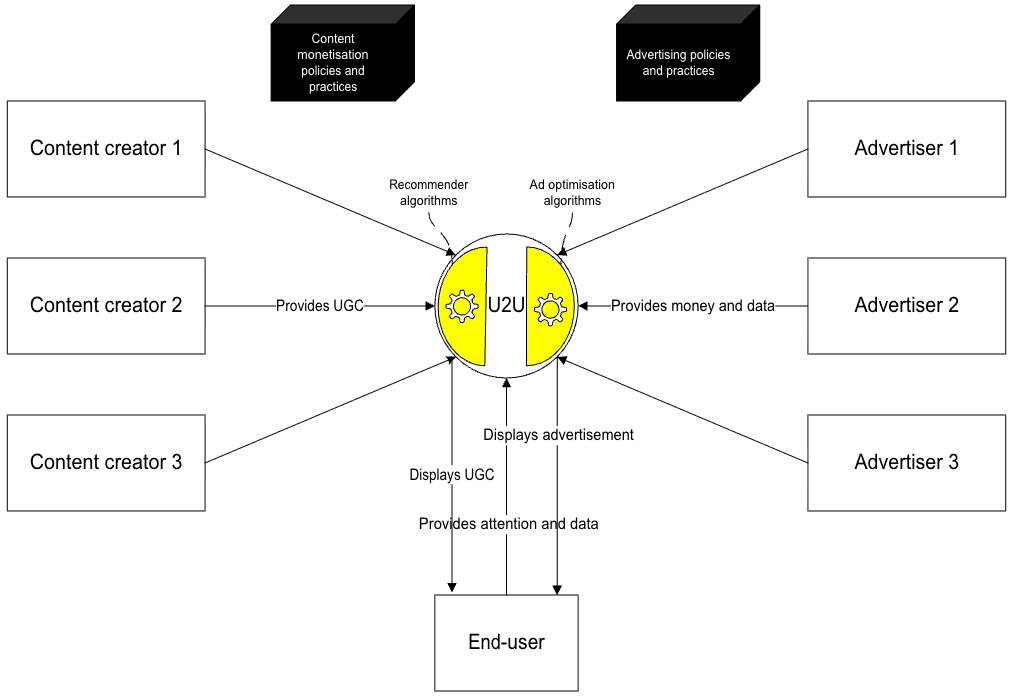
The natural incentive structure for U2U platforms, which are profit-driven companies accountable to shareholders for share price growth, pushes them, absent regulation or ethical guardrails, to maximise advertising revenue above all else. In practice, this means accepting any advertiser willing to pay, onboarding any content creator willing to produce, and engineering the platform to keep end-users consuming UGC and ads for as long as possible, while nudging them to interact with ads more frequently.
There is no inherent incentive for U2U platforms to verify advertisers or moderate content, because the key to massive revenue generation in this system is the positive correlation between sheer volume of content and saturation of ad placements, compounded over time. Currently, there are no industry-governed or regulatory-enforced requirements for platforms operating in the UK to verify the ownership of advertiser profiles. To be clear, the Advertising Standards Authority and the Committee of Advertising Practice, in their role as self-regulators in the public interest, do not cover or require advertiser verification, nor do they govern any digital platform’s approach to monetisation.4
In such an environment, platforms can unilaterally define and selectively enforce content monetisation and advertiser policies, making a plethora of online harms profitable. For example, in November of 2025, Reuters found that Meta continued to allow advertisers suspected of running scams to continue participating in digital ad auctions; instead of enforcing the policies for scams, it may report to regulatory agencies and consumers, but Meta simply charged those suspected scam advertisers an undisclosed surcharge to participate in the auction.5 The company even created a “playbook” to respond to international regulatory pressure to crack down on scammers on the platform.6
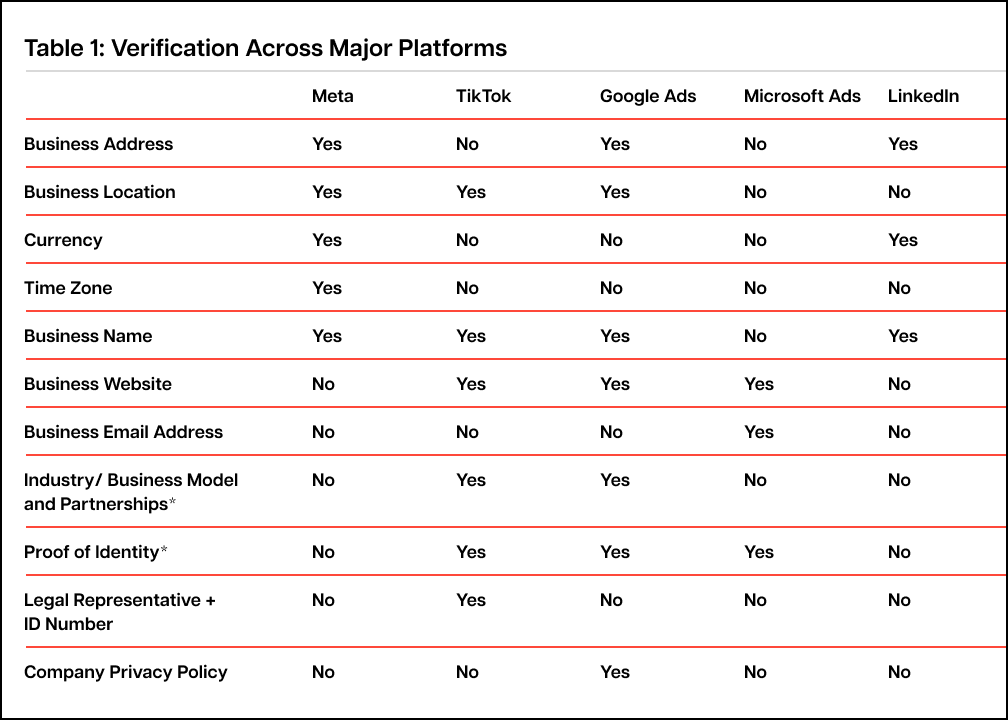
The OSA requires providers of internet services to assess the risks their services pose and to design proportionate measures to mitigate online harms, including in the case of fraudulent advertising. Section 8 complements this duty with a transparency reporting obligation, enabling Ofcom, researchers, and civil society to evaluate the adequacy of providers’ risk assessments and mitigation measures, and to hold providers accountable where these fall short. Our own research in advertiser verification processes on major platforms indicates that current measures are inadequate (see the table below). This needs to be changed, and meaningful asks in the transparency notices can help.
Check My Ads Recommendations
The text of the OSA itself provides ample basis for requiring providers to be transparent about their business models, including how they decide which advertisers to accept, which content to monetise, and how their algorithms support content monetisation and advertising optimisation.
Schedule 8, Paragraph 8 requires transparency regarding “features, including functionalities, that a provider considers may contribute to risks of harm using the service, and measures taken or in use by the provider to mitigate and manage those risks.” Paragraph 9 extends this to “the design and operation of algorithms which affect the display, promotion, restriction or recommendation of illegal content, content that is harmful to children, relevant content or content to which section 15(2) applies.” Read together, these provisions plainly reach the monetisation logic and ad delivery systems that drive how harmful content travels on a platform.
Specific recommended items for inclusion in transparency reports:
1. Duties of Care: Advertiser Governance
If platform’s advertiser onboarding processes are ineffective, and its Know-Your-Customer (KYC) checks cannot adequately verify the identity of advertisers, this can be considered a feature of the U2U platforms that may contribute to or fail to prevent the risks of harm to end-users. These processes and policies decide who can pay to reach users of the internet service. With this in mind, we believe the platform transparency notices should include information about:
- Criteria and processes (including any differential treatment) for accepting, refusing, and suspending advertisers, including when this happens through automated means or through human review.
- Number (#) of advertisers that were accepted, broken down by their country of incorporation (and where available, country of beneficial ownership), and the industry type they represent (e.g., gambling, alcohol, financial services as regulated by the FCA, high fat, salt, sugar food products (HFSS)), as well as the amount (£) received by the platform from them (aggregate).
- Number (#) of advertisers that were rejected or removed after campaign launch, as well as their share (%) from all advertisers attempting to onboard, broken down by type of policy violations (aggregate)
- The total (£) amount of advertising revenue the platform received from policy-violating advertisers before the advertisers were suspended.
- Number (#) of advertisers suspended who were subsequently identified attempting to re-onboard under a different entity (aggregate).
- Number (#) of policy-violating ads shown to end-users, before the advertiser was suspended (aggregate).
2. Duty of Care: Content Monetisation Governance
Similar to advertisers, UGC creators and news publisher content onboarding processes are also subject to variable, unenforced KnowYourCustomer (KYC) processes. This lack of standardisation can be understood as a feature that may contribute to risks of harm to end-users. Platforms unilaterally decide which UGC creators and news publisher content are allowed to be monetised and, therefore, which UGC creators and news publisher content are permitted to reach users of the internet service.
We therefore believe that the platform transparency notices should include information about:
- Criteria and processes (including any differential treatment) for accepting, refusing, and suspending monetised publishing creator accounts, including when this happens through automated means or through human review.
- The amount (£) of advertising money the platform shared with policy- violating publishing creator accounts before the account was suspended (aggregate).
- Date of payout(s) for publishing creator accounts.
- Additional information on this matter, as outlined in What To Fix’s submission to Ofcom.
3. Business Model Transparency
U2U platforms make a plurality of their revenues from offering digital advertising services to advertisers. These services are predicated on reaching a large audience of users to serve ads to make money. We believe that any effort for the OSA to have a meaningful impact in curbing online harms, the platforms’ transparency reports should include information about:
- Full pricing breakdown of their advertising services and advertising auctions. The disclosures should ensure that there are no hidden fees or markups, and that UGC creators and news publisher content and advertisers understand the platform decides on fees and charges in every transaction.
- Auction metrics, which are used to decide which content the ad is shown, how ads are selected, optimised, and targeted.
- Algorithmic targeting products like Google’s Performance Max, Meta Advantage+, and TikTok’s GMV and Smart+, which are currently a black box.
- Recommender systems, including the criteria used, to moderate content.
4. Risk Assessment
Where the business model is itself a driver of harm, the risk assessment must engage with the business model as a unit of analysis, not only with individual content categories or features. Platform transparency reports should disclose the actual and potential adverse impacts associated with each revenue stream the platform operates (advertising, creator monetisation, commerce, subscriptions, etc.), assessed individually, as well as the adverse impacts arising from interactions among revenue streams. For example, how ad-engagement signals influence organic content ranking, or how creator monetisation incentives interact with ad placement. Platforms should also disclose the actual mitigation measures to prevent potential harms stemming from their business models.
5. Ad Archives
U2U platforms should also be encouraged to keep digital ad libraries. Currently such archives are not built to a consistent, enforceable standard and therefore are currently unfit for use. By way of example, neither users nor researchers can search Google’s Ad Library by ad content. Rather, these stakeholders can only search by (1) the name of the advertiser or the advertiser’s website and (2) the geographic location of where ads ran. Ad library repositories also vary in retention length: for example, Google and Microsoft’s libraries only retain ads for one year while Meta’s digital ad library only shows ads while they are live, with an exception for political advertising.
The risk of harm posed by U2U business models to the digital environment cannot be overstated. While Reuters’ 2025 report highlights the pervasiveness of the issue on Meta platforms, other platforms engage in similar misbehaviour, which, in each iteration, makes the internet more dangerous and less usable for consumers. Recent reports indicate that 95 billion scam ads were shown to Britons on social media in 2025, and victims lost an average of £1,258 each from these scams.7
Increased transparency about the monetisation pipeline protects both legitimate advertisers and publishers, as well as users, from abuse of the system by bad actors, and the platforms that extract value from these exchanges without a second thought. Transparency notices can prevent platforms from profiting from business models that incentivise online harms when they are designed without verification mechanisms.
Transparency requirements allow watchdogs to hold platforms accountable for implementing safety requirements, incentivising downstream compliance with other safety regulations that platforms would otherwise be able to ignore.
We are happy to support Ofcom at any time in discussing the adsupported monetisation of regulated UGC.
Sincerely,
Lex Zard
Director of Policy
Iesha White
Director of Intelligence
About Check My Ads
Check My Ads Institute is an independent 501(c)3 nonprofit global digital advertising watchdog, headquartered in the US. Our organization serves the stakeholders that are most impacted by the digital advertising ecosystem: publishers, advertisers, policymakers, small businesses, and the public. We help these stakeholders navigate the complex industry and understand not only how advertising budgets flow, but how they shape the information ecosystem, often disappearing before ever reaching real people.
Our mission is to bring transparency and accountability to the notoriously opaque and purposefully complex digital advertising ecosystem. The global advertising industry has grown to be worth more than $750 billion USD and is among the world’s largest unregulated industries.
Check My Ads has advanced market reform by providing stakeholders with new ways to demand accountability from Big Tech and AdTech. We work globally with policymakers to advance many commonsense safeguards to protect the public. We are pushing for reforms to apply the same rigorous standards required in the finance industry to the digital advertising industry, including supply chain transparency, Know-Your-Customer requirements, best interest duties for adtech brokerage intermediaries, and common ownership rules.
Our work with advertisers and advertising practitioners demonstrates how the current system allows advertising budgets to unintentionally fund harm and waste, to the detriment of brands and their growth. We also explore how adtech business practices contribute heavily to starving quality publishers of digital advertising revenues. We do not accept any money from tech companies. We are proud to be fully independent and free from industry influence. Our advocacy is driven by facts and the desire to make the internet fairer for all who use it.
Check My Ads exists to empower the people and organizations most affected by the broken adtech system. By shining a light in the dark corners of this opaque ecosystem, we push for systemic changes that will reform how the internet is funded – and, in turn, how it serves and protects all of us.
Learn more about our research and our policy platform at www.checkmyads.org.
Endnotes
- See Ofcom, Protecting people from illegal harms online: Guidance on content communicated “publicly” and “privately” under the Online Safety Act, https://www.ofcom.org.uk/siteassets/resources/documents/onlinesafety/informationforindustry/illegal-harms/guidanceoncontentcommunicatedpubliclyandprivatelyundertheonlinesafety-act.pdf?v=388093 (5). ↩
- CHOOSE HOW YOU WANT TO MONETISE YOUTUBE HELP, https://support.google.com/youtube/answer/94522?hl=enGB#zippy=%2Cturnonadsforindividual-videos (last visited May 5, 2026) ↩
- META CREATORS, FAST TRACK YOUR GROWTH. GET GUARANTEED PAY JUST FOR POSTING., https://www.facebook.com/creators/creatorfasttrack (last visited May 6, 2026) ↩
- SCOPE OF THE CODE, https://www.asa.org.uk/type/non_broadcast/code_folder/scopeofthecode.html (last visited Apr 29, 2026) ↩
- Jeff Horwitz. Meta is earning a fortune on a deluge of fraudulent ads, documents show. Reuters. (November 5, 2025). https://www.reuters.com/investigations/metaisearningfortunedelugefraudulent-adsdocumentsshow-2025-11-06/. ↩
- Jeff Horwitz. Meta created ‘playbook’ to fend off pressure to crack down on scammers, documents show. Reuters. (December 31, 2025). https://www.reuters.com/investigations/metacreatedplaybookfendoff-pressurecrackdownscammersdocumentsshow-2025-12-31/. ↩
- Karl Matchett. Revealed: 95 billion scam adverts shown to Britons on social media last year. The Independent. (February 10, 2026). https://www.theindependent.com/news/business/tiktoksnapchat-instagramsocialmediascamsb2917242.html. ↩