


Content warning: This story discusses suicide.
Just days after Nancy Arnold’s 20-year-old son died by suicide, a friend showed her an obituary — one she had no hand in writing.
“I went online, and I Googled him. My boy’s name,” Arnold recounted in an interview.
What she found caused her such distress, she recalled, that she fell to the ground.
The grieving mother had found her recently deceased son’s name at the center of a new, ghoulish scam: sites loaded with ads using apparently AI-written obituaries to drive traffic.
And adtech companies are sending them money, even when it’s against their policies.
We know, because an adtech company told us. And after we asked the adtech companies about it, the sites we investigated appeared to scrub the spam obituaries.
What is this scam?
According to research from SecureWorks, scammers “monitor Google search trends to identify heightened interest in obituaries, especially during the initial hours or days following a death.”
“They then fill the information void with mock obituaries hosted on funeral or memorial-themed websites,” the SecureWorks analysis explained.
And obituary spam is a growing problem. The Verge documented its rise in February, and last month Fast Company highlighted even more sites pumping out obituaries likely written by AI.
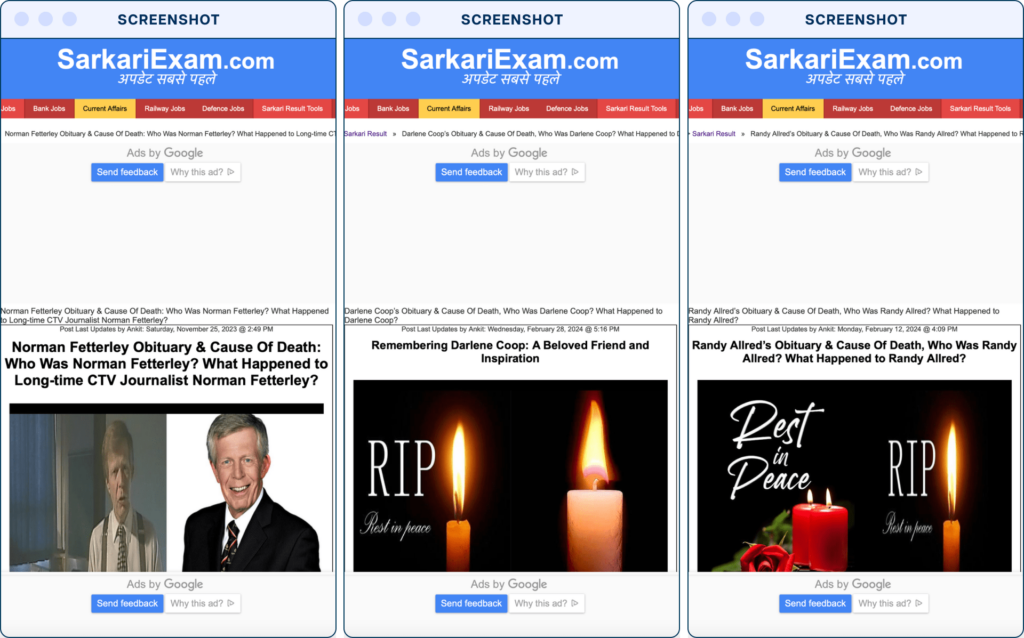
By gaming search results with optimization tactics, these sites often show up high in the results, sending family and friends looking for answers to sites pushing “adware” or “other clickbait revenue-generating schemes.”
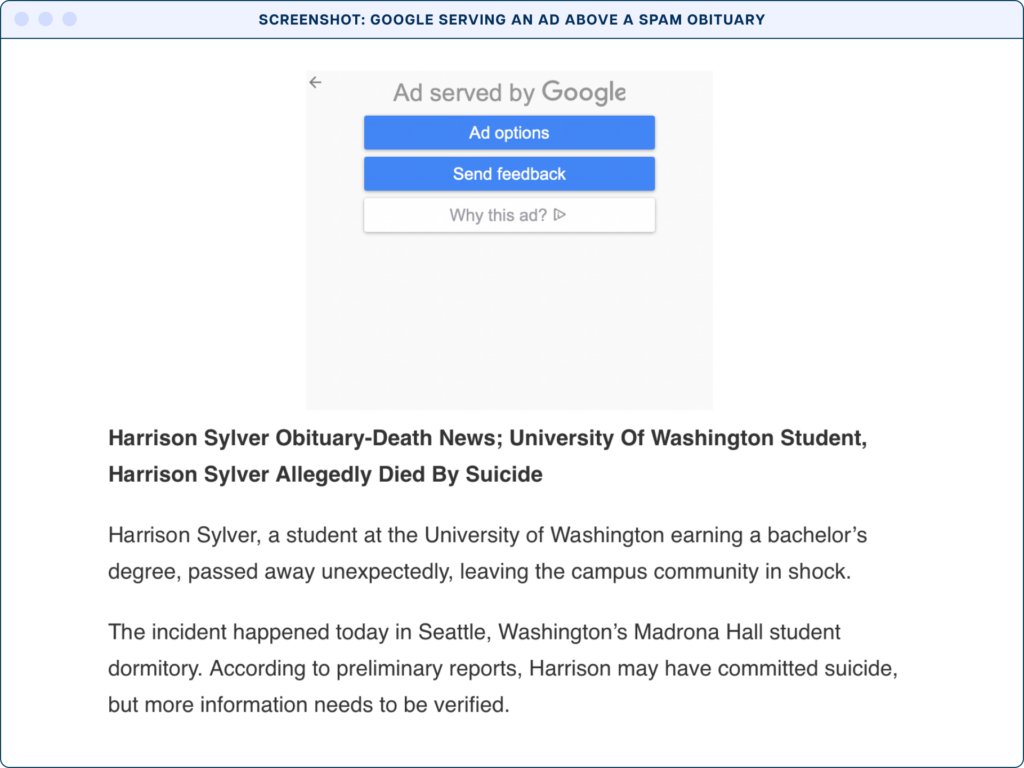
This was what Arnold was met with when she Googled her son, Harrison Sylver. She said her search returned “maybe 25 or 30” of these scam websites, all “with his name, and all with facts that were completely untrue.”
Headlines included wording like “Harrison Sylver, dead by suicide. How did this happen?” and “Harrison Sylver […] dies by self inflicted gunshot wound to the head. Get the story here,” Arnold recounted.
“My son died by suicide. He did not shoot himself in the head,” she explained.
In addition to the manner of her son’s death, the websites got several deeply personal details wrong, including where he grew up, his hobbies, his living situation and where he was found.
“I was sick to my stomach,” she said.
“I’m going to actually start crying, remembering how terrible it was to see my baby’s name in print like that.”
“I was like, oh my god, who doing this? who’s doing this?”
Who is behind these posts?
The adtech industry, which encompasses the entire business of buying and selling ads you see online, has a problem: despite being worth about $700 billion, there’s almost no oversight.
The shred of accountability that does exist within this industry tends to be voluntary, and, according to ProPublica and Digiday, several companies don’t disclose who they’re working with (or lie about it). That means most advertisers don’t actually know what their ads end up funding.
For scammers willing to put in a bit of digital elbow grease, it’s a gold mine.
Check My Ads investigated several websites that appeared to take advantage of this lack of oversight and pocketed the profits from running ads next to obituary spam.
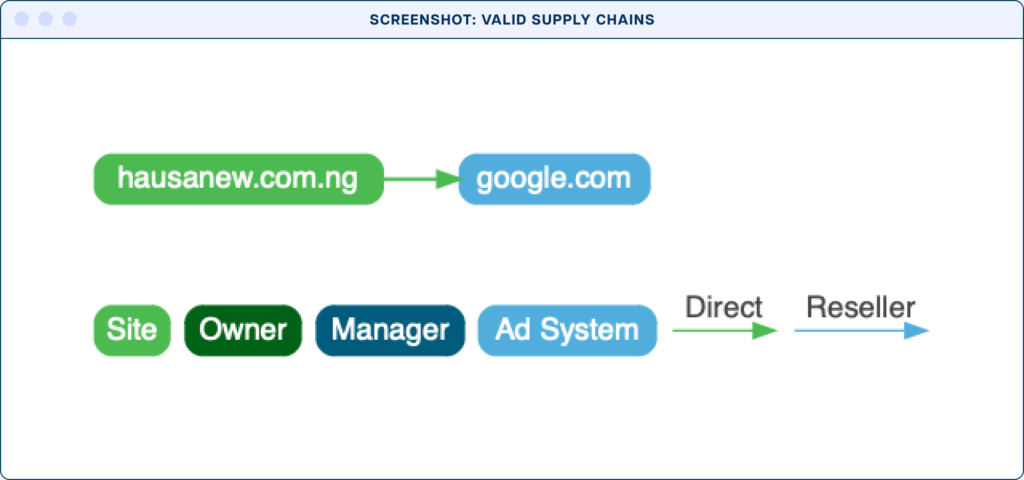
Using the site well-known.dev, we mapped out connections between these sites and the companies placing ads on them. It’s important to note that the data used to make connections is self-reported between ad sellers and the companies providing ads, and may not always be up to date or accurate.
HausaNew.com.ng, one site that Google appears to monetize with ads, featured an obituary about Arnold’s son.
It contained incorrect information — including about where her son was found.
Another website, SarkariExam.com, engaged in this practice with the help of multiple ad systems. While it didn’t run an obituary about Arnold’s son, we found multiple impersonal memorial posts littered with ads.
Following our investigation and requests to ad exchanges for comment, both websites — SarkariExam.com and HausaNew.com.ng — appeared to completely wipe the spam obituaries from their websites.
However, they’re far from the only ones engaging in this practice.
Is anything being done about this?
We reached out to ten ad exchanges monetizing SarkariExam.com. Only two of them actually got back to us.

TripleLift, a programmatic advertising platform, said it has launched an internal investigation and pledged to reword its policy to make it clear this type of content is unacceptable.
“We’re in the process of adding this domain to our platform wide blocklist and investigating the partners that sent us the inventory further,” said Ryan Levitt, TripleLift’s vice president of communications.
He confirmed that SarkariExam made less than $100 through Triplelift over the past two years.
Nothing in his company’s policy “explicitly prohibits the monetization of AI/spam obituaries,” Levitt explained, “but we do state that the following is prohibited ‘Content that is misleading, libelous, invasive of others’ privacy, or otherwise harmful to TripleLift’s reputation.’”
“We consider AI/spam obituaries to fall in this category and plan to add specific language to our Supply Policy in order to better clarify this — however, we do think our current wordage does cover this issue,” he said.
Google also got back to us after we highlighted its role in placing ads on both SarkariExam.com and another website, HausaNew.com.ng, which featured a fraudulently, error-laden obituary about Sylver’s death.
“We’ve looked into the examples you shared and taken the appropriate action. When we find content that violates our publisher policies, we take action and remove ads from serving. We enforce our policies at both the page-level and site-level,” a Google spokesperson wrote in a statement. They added that they blocked or restricted ads from serving on “more than 2.1 billion publisher pages” last year.
Google did not clarify if the spam obituary websites, including the one that published false information about Arnold’s son, were compliant with their policies.
“We don’t share specifics of our enforcement signals and systems, as bad actors will often use this information to undermine our efforts and evade enforcement,” the spokesperson said.
However, the week after we first notified Google, the obituary for Sylver on HausaNew.com.ng — and a large portion of the site itself — were no longer accessible. Attempts to access the site were forwarded to a smaller subdomain, travels.hausanew.com.ng, and the search engine on the site said there were no results for “obituary” or “Harrison.”
After we followed up with Google for details on its enforcement actions, previously active links for SarkariExam.com’s obituary spam, such as this archived one, no longer worked. While a Google search for the term “obituary” limited to SarkariExam.com returned several results, the links all appeared to redirect to its other pages, not the obituaries.
None of the others ad exchanges Check My Ads contacted — including Teads, Sovrn, mgid, mCanvas and Affinity — responded.
Meanwhile, without a widespread effort to regulate publisher inventory and prohibit these painful profiteering, families continue to be confronted with the cruel practice.
Arnold told Check My Ads she has a message for the folks profiting from her pain.
“It is just so hurtful to see your child’s name, at the worst possible time of my entire life, to see your child’s name and legacy…tainted with lies for the rest of his life on the internet,” she said.
“That is so heartbreaking for an already desperately heartbreaking situation.”
We will update this story if any other ad systems respond or take similar action to change their policies.
Have you been affected by this issue? We’d love to speak with you about it. Contact us: [email protected] or [email protected].