
On June 11, 2026, AdWeek reported that Google and The Trade Desk, two major digital advertising platforms, did not renew their accreditations with the Trustworthy Accountability Group (TAG).
While this turn of events may read like two major corporations turning their backs on an organization that aspires to preserve brand safety, especially in context of similar and familiar stories of big tech platforms opting out of safety audits. And while that’s partially true, this would be a misunderstanding of the power dynamics at play.
TAG describes itself as “the leading global initiative fighting criminal activity and increasing trust and transparency in digital advertising” advancing its mission by “connecting industry leaders, analyzing threats, and sharing best practices worldwide.”
AdWeek reported that “the decision from two of the world’s biggest advertising platforms to let their certifications lapse, however, suggest that TAG’s influence is diminishing.” Google allowed its TAG certifications to lapse while upholding certifications from the Media Rating Council (MRC), another organization meant to serve as a self-regulatory body for tech platforms.
In 2017, TAG registration become mandatory for membership in the Interactive Advertising Bureau (IAB), a trade organization that self-purports to “[empower] the media and marketing industries to thrive in the digital economy,” boasting members such as Google, Meta, Snapchat, TikTok, Amazon, Microsoft, and more.
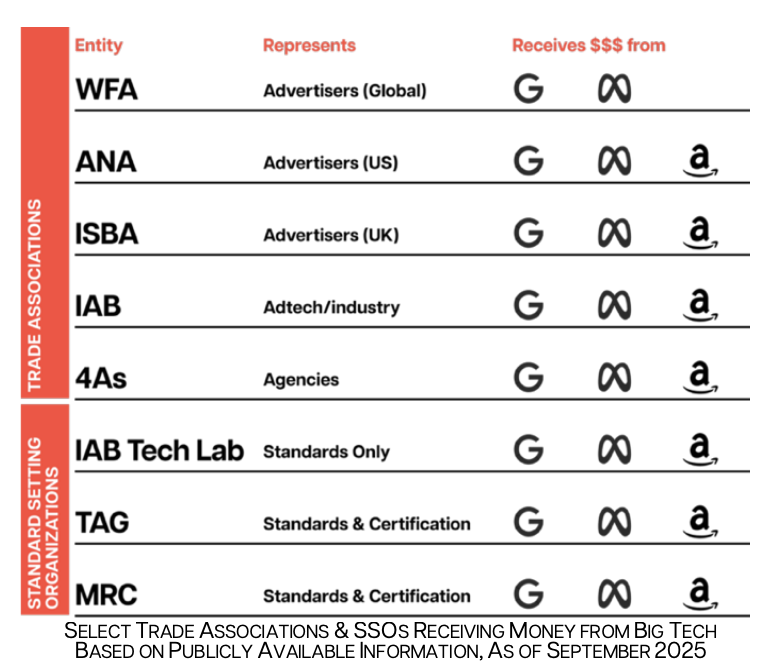
Source: Check My Ads Institute Comments on MRC Digital Advertising Auction Transparency Standards
However, IAB is not the only organization with this requirement. The Association of National Advertisers (ANA)’s updated media buying contract includes what is essentially a de facto requirement to be TAG certified (and MRC-accredited). At the same time, nearly all of the major trade associations and standard setting organizations take money from Google, Meta, and Amazon — three of the biggest players in the digital advertising market. This begs the question: are these trade bodies and standards orgs truly promoting standards that benefit the industry, or are they proxies through which the largest players get to decide the rules for everyone, and raise barriers to entry along the way?
A Fig Leaf for a Fig Leaf
TAG was recently in the news for its launch of a new initiative to crack down on pirate ad revenue from stolen FIFA World Cup streaming, claiming to have cut off advertising to 1,376 sites containing illegal or stolen content from the event. While TAG may have cut off monetization to these sites, it has itself admitted that a significant portion of these sites were found by outside entities (such as government bodies around the world, industry partners, and other TAG members), and that TAG then added these contributions to its Pirate Domain Exclusion List (PDEL) to stop the monetization of these sites with stolen content. This was done via the organization’s AdSec Threat Exchange, “an early warning sign to be able to identify and be able to stop illegal activity across the ad supply chain.”
Yet, while TAG may have taken a hard stance on piracy for the World Cup, its track record is not quite so consistent.
TAG came under fire in 2025 when Senators Marsha Blackburn and Richard Blumenthal opened a congressional inquiry regarding the monetization of child sexual abuse material (CSAM) by adtech vendors who facilitated the programmatic advertising auctions that funneled advertiser money to publishers of the illegal content. The Senators asked both TAG and the MRC if any of their vendors had reported CSAM content, as well as requesting documentation of past examples of certification and the revocations or suspensions of certifications for noncompliant accredited members.
TAG essentially answered with a non-answer — its regular modus operandi. The organization consistently underscored its mission of promoting brand safety, the elimination of fraud, and the enablement of transparency throughout the document, without providing any material information about next steps towards implementing the goals it claims to serve. The Senators were perhaps lucky to receive an answer at all. Check My Ads is yet to receive a response regarding our complaint, despite TAG’s timely (and performative) rollout of its educational partnership with the National Center for Missing and Exploited Children (NCMEC).
However, while TAG and MRC offer certification to participating companies, they very rarely revoke the accreditations. Under the guise of self-regulation, these organizations actually serve to enable powerful corporations to set the standards upon which the entire advertising technology industry relies. The companies that have the biggest stake in the “rules” for the industry get to make them. The performance theater of these organizations is fueled by the use of palatable words like industry accountability or standards. But the recent move by Google and The Trade Desk illustrates just how trivial these standards truly were to the companies that make the internet what it is. To echo our comment on the MRC auction transparency standards in 2025, “if everything is optional, then nothing is a standard.”
TAG and the MRC both facilitate their audits behind closed doors, without clear public guidance as to what a certification by these entities actually means. A significant part of TAG’s regular auditing it that it advertises as a key element of its certification process are quarterly self-audits; in other words, companies can be audited for compliance by telling TAG what TAG, and the rest of the brand safety world, want to hear, and TAG marks a big check next to their name for the next three months. TAG does require the prospective organization to “invite an independent auditor to review and validate” compliance to attain the Brand Safety Certified Seal. For its part, the MRC outsources most of its auditing to consulting firm EY, paid for by the member organizations with a price tag ranging from hundreds of thousands to more than a million USD. (Fun fact: EY is also Google’s own auditor. Conflict of interest, anyone?). MRC has contracted Deloitte for specific auditing projects as well.
So why even get TAG certified in the first place? TAG Certification, along with MRC accreditation, was the key to the brand safety and ad fraud cop-out mechanism for major platforms. It was a warm hug for brands that worried about their investment and brand reputation while delving into the wild and opaque world of digital advertising. And, at the same time, if brand safety violation accusations or fraud scandals came out against platforms, platforms could invoke their TAG certification or MRC accreditations as a forcefield to protect themselves from the backlash. Companies could emphasize their commitments to brand safety, sing the praises of self-regulation, and continue to do exactly what they were doing in the first place. As Augustine Fou told The Register in 2019, “First, it enables fraudulent companies to operate in broad daylight by paying the fee and waiving their TAG seal around. And second, it is a racket that extorts fees from good companies that didn’t need to be certified in the first place, but get painted with the same brush as fraudsters.”
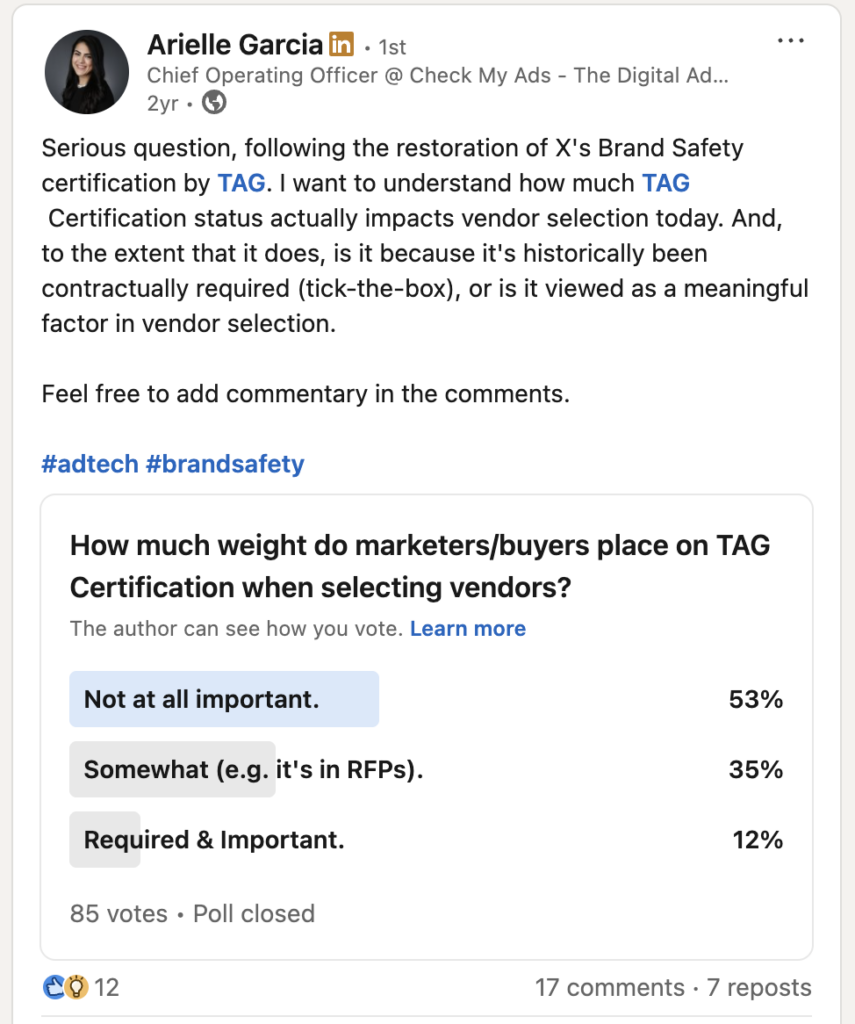
A LinkedIn poll performed by Check My Ads COO Arielle Garcia in 2024 asked respondents “How much weight do marketers/buyers place on TAG Certification when selecting vendors? The overall consensus: of little to no significance.
At the end of the day, TAG offered companies a seal of protection that didn’t mean all that much. No one ever had to be truly brand safe, they just had to pay TAG to say that they were.
TAG has acted as a highwayman, facilitating the stealing of ad revenue from publishers in the digital advertising pipeline, all in the name of brand safety. Instead of fostering an ecosystem based on quality metrics such as brand safety, the organization has accelerated the legitimization of the digital advertising infrastructure that hides behind certifications to obfuscate the true recipients of advertising dollars, and the collateral damage to publishers and consumers downstream. For example, an academic research article from 2025 indicated that brand safety providers DoubleVerify, Integral Ad Science, and Oracle were discrepant in their classifications of news articles for brand safety — a strange finding considering DoubleVerify and IAS remain certified by TAG (Oracle met its demise in late 2024). As such, it’s evident that even with a TAG stamp of approval, its definition of “brand safety” is a sham.
For more than two years, we have been asking questions about TAG and MRC, and about the governance models of these entities purporting to promote a transparent and accountable ecosystem. We are yet to receive any meaningful answers. ****In fact, TAG has walked back its explicit pathway for third-party complaints (despite telling Congress otherwise), while MRC closed its doors to “public comments” from non-members shortly after we submitted ours.
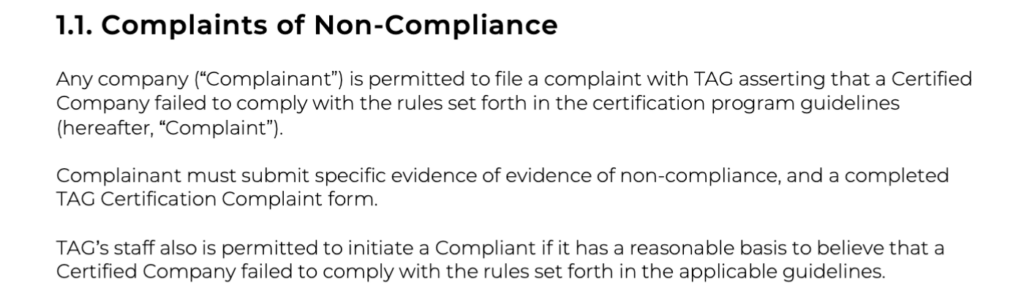
TAG Due Process for Allegations of Non-Compliance & Appeal | Version 2.0 (January 2018) explicitly allows “any company” to file a complaint with TAG.
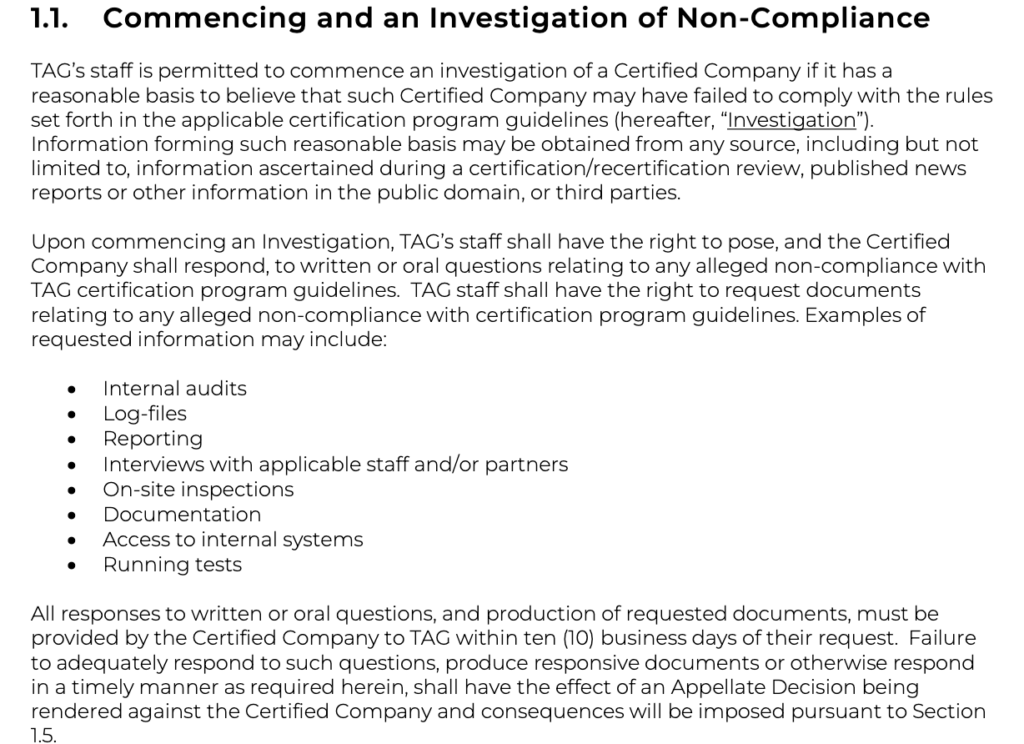
TAG Due Process for Allegations of Non-Compliance & Appeal | Version 3.0 (May 2024) removes mention of third-party complainants, leaving the decision of opening an investigation solely in TAG staff’s hands.
At Check My Ads, we work fairly. We fight for transparency, and we act in a way that is consistent with the behaviors we advocate for from other corporations. The same cannot be said for TAG.
The Bigger Question: Who do Trade Organizations Truly Represent?
Ultimately, the trade organizations that are meant to protect the interests of platform stakeholders only serve the organizations they are meant to police. The inevitable failure of self-regulation has only allowed these organizations to operate under the guise of internet governance, while in truth enabling the misbehavior of platforms in favor of their bottom lines.
As Google and The Trade Desk have demonstrated, these organizations are so ineffectual that large platforms are reconsidering the value of even a guise of TAG’s certifications anymore.
This exodus has provided these overlooked stakeholders with an opportunity: brands and publishers must demand their trade bodies represent their interests in setting and enforcing the standards for digital safety, particularly with the platforms that currently control the market.
Here’s how they can do that.
- Demand, as a condition of membership, for trade associations and standards bodies to publicly disclose how much of their funding they receive from Big Tech.
- Ask whether the charters or bylaws of these trade organizations contain any caps on revenue that can be derived from a single partner or stakeholder set (for example, publishers, advertisers, platforms, DSPs, SSPs, etc.). These revenue caps are an important tool to make sure that platforms can’t exert additional fiscal pressure on the trade organizations meant to govern them.
- Ask whether the rulemaking protocols of these trade organizations contain any caps or requirements for diversity of industry viewpoints represented. Balancing interests so everyone has an equal seat at the table ensures that brands aren’t stuck in the nosebleeds while platforms have backstage passes.
Change is possible.
Take IAB Sweden, which expelled Meta for its handling of fraudulent advertising this past spring,which accounted for approximately 10% of its 2024 revenue. Meta notably did not appeal the decision, and was removed from the board and had its membership revoked. Brand safety was a top concern for Swedish advertisers, and the IAB chapter recognized Meta as a perpetrator of this issue in its decision to remove the company. Swedish publishers Bonnier News and Schibsted led this charge, with support from Aller Media, which in their respective statements underscored the companies’ responsibilities towards their customers, and how Meta’s misbehavior and concurrent membership in IAB Sweden was misaligned with those values.
The IAB Sweden case study is a rare example of a trade organization holding a platform accountable for the interests of its stakeholders – not just the largest players. This is what is possible when trade bodies that purport to represent the whole ecosystem actually live up to their stated mission. This is what it might look like if trade bodies weren’t so financially reliant on the largest adtech players.
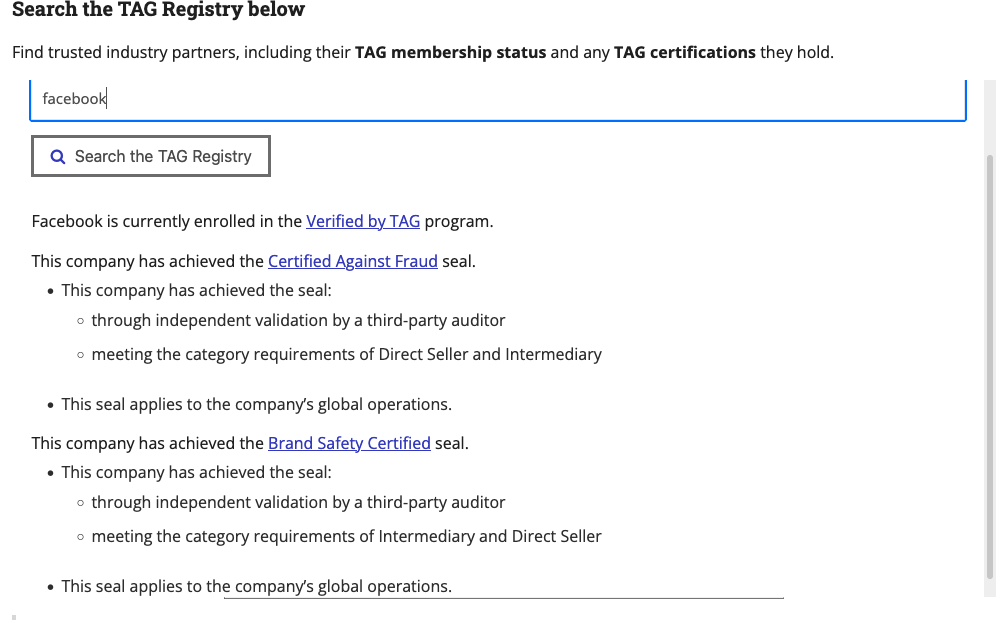
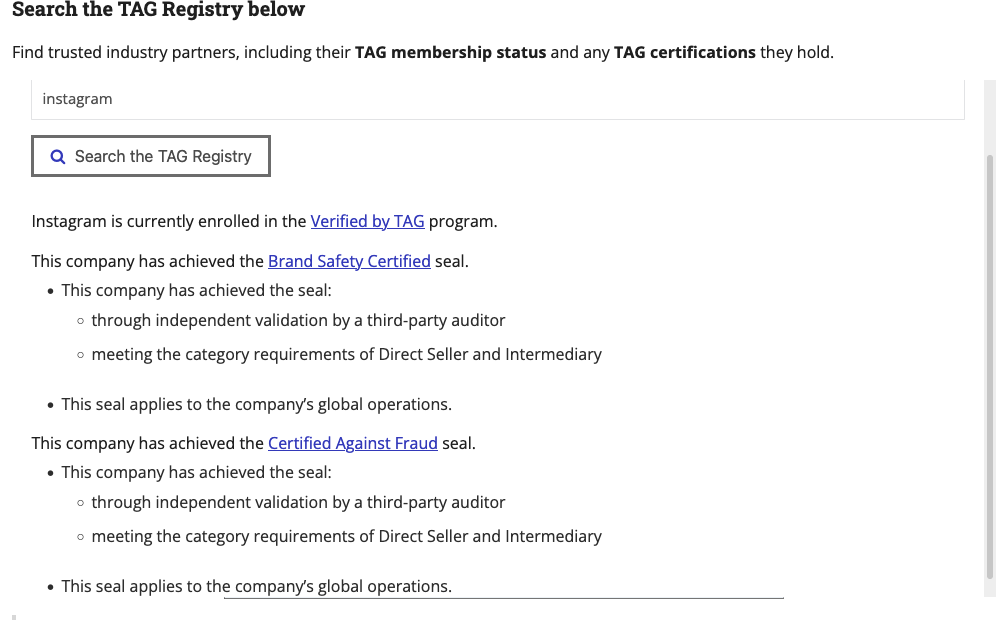
But it’s only one step in the right direction. Despite the pressure created by the Swedish trade body for its other jurisdictional counterparts to follow suit, other IAB chapters (such as IAB UK) instead stood by Meta “to work with the broadest possible membership to help make digital advertising better for everyone and address shared industry challenges.” This is despite a July 2026 BBC investigation finding that Meta not only had allowed ads promoting CSAM to run in India, but had also originally found that the ads did not violate their brand safety policies. As of today, Meta’s two flagship advertising platforms, Facebook and Instagram, remain TAG certified for Brand Safety at the global level, and Meta remains a IAB UK member to boot.
Many of the largest trade associations and standards bodies remain subject to the pressure of the large platforms that fund them, while they use the name of the organizations to sign their own permission slips and lobby for their interests. All the while, they force the hand of brands and publishers to be compliant with the arbitrary standards the organizations have set. Publishers and independent adtech firms spend large sums of money to acquire and maintain a certification to bolster market confidence , despite the general consensus of the certification’s overall uselessness. So stop paying the TAG tax. Google’s not doing it. The Trade Desk isn’t either. And most marketers don’t seem to care. Neither should you.