

The upcoming Google antitrust trial could change the world. So we’re helping you understand it.
In our last explainer, we broke down the overall adtech ecosystem — and why the Department of Justice believes Google has a monopoly on it.
Now, let’s get into the weeds a bit.
For our second explainer, we’re talking about the buy-side of the adtech industry: the place where the demand for advertising space comes from.
We’ll be looking at the main players, Google’s role, and why brands don’t usually know anything about where their advertisements actually end up (that’s where things get juicy).
What is the buy side?
If you’re reading this breakdown, you should have already read our last one. If you haven’t, go read it and come back. We’ll wait.
All done? Perfect.
So you now know that the process of buying and selling ads is mostly automated these days, with a sell-side offering up ad space, a buy side making an offer, and an ad exchange automating that auction process.
The buy side is made up of advertisers, their ad agencies, and the tools that they use to buy ad space. They’re the “demand” part of the transaction.
Advertisers and their agencies want to reach an audience with their ads, and they do that by competing in auctions for ad placements. The placements usually come with promises about how many eyeballs from what kind of person will see the ad.
This audience information is often hilariously inaccurate, but that doesn’t seem to matter much.
When our Director of Intelligence Arielle Garcia inquired about the data being sold about her online, she learned that she’s apparently the mother to two children, Asian, both high income and below the poverty threshold and celebrates Ramadan.
None of that is accurate. Yet that data will be used to apparently “target” her with user-specific ads.
Arielle isn’t some outlier here. A 2019 study found that, for example, data brokers only get a user’s gender right about half of the time. This garbage data is a huge part of why newsrooms are struggling to stay afloat. It’s what drives the value of ad inventory, rather than the quality or credibility of the website itself.
Regardless, ads are still served up based on this bad data — and fast. The whole thing is automated and it happens in the blink of an eye.
In the time it takes for a webpage you’ve clicked on to load, any personal information stored in your browser is assessed, the value of your eyeballs is given a price, and the bidding war takes place.
A brand wins the auction — and you see their ad.
Capisce?
If this is all about advertisers, what does Google do here?
Google has this fun little product they offer called “Google Ads.” According to the Department of Justice, it makes up about 80% of the market share of advertiser ad networks.
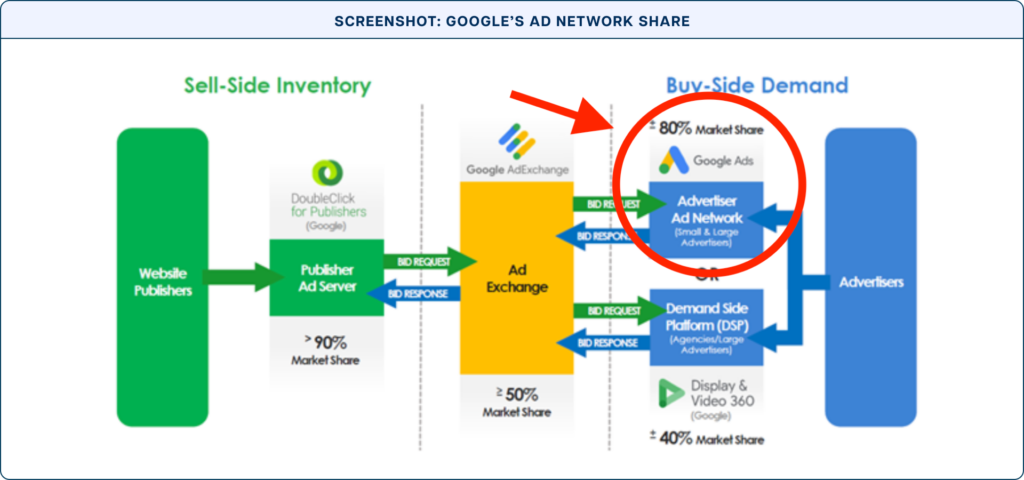
An ad network like Google Ads is basically a broker between a group of publishers and a group of advertisers, large and small. In giving their ad budget to Google Ads, brands can access all of Google Owned & Operated properties (like Search and YouTube) and publishers (websites and apps) that Google Ads works with. The Google Network includes both the Google Display Network and Search Network. Publishers working with Google Ads also get to access this massive group of advertisers, big and small.
So instead of trying to engage in programmatic auctions themselves, brands hand their money to over Google Ads. Google Ads makes the brands promises about the audience that a set price will let their advertisement reach. Then it turns around and spends that money on advertisers’ behalf.
Another product Google offers here is Display & Video 360. This is a Demand Side Platform, or a DSP — and Google’s product takes up about 40% of the market share here, according to the Department of Justice.
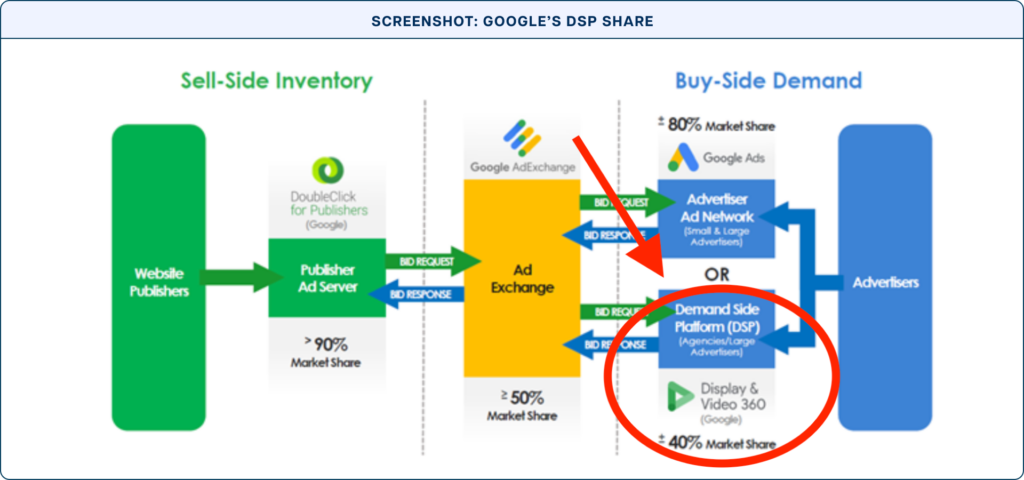
DSPs are different from ad networks in that they offer advanced targeting, more cost models, and more reporting, which means they’re more likely to be used by large advertisers that have bigger budgets, more resources, and often a media agency to manage their campaigns.
The Display & Video 360 DSP is part of the larger “Google Marketing Platform” along with Google’s advertiser ad server (Campaign Manager 360), as well as Search Ads 360, Tag Manager, and Google Analytics.
With Google Ads, advertisers primarily access supply — meaning the websites where they’d bid on and buy ad space — from Google AdExchange. But Display & Video 360 can work with other third-party ad exchanges or Supply-Side Platforms (SSPs).
While advertisers have the option to work with other companies than Google to buy ad space and access websites, they’d lose out on a lot of potential views if they don’t choose to go through Google. For example, you know the ads you see at the top of a Google Search result? (You know, the same Google Search that Google has a monopoly on, according to a court ruling). You can’t access that ad placement unless you use Google’s buy-side products, because it’s part of Google’s Owned and Operated inventory.
Google has set things up in a way that advertisers can’t really afford not to work with them.
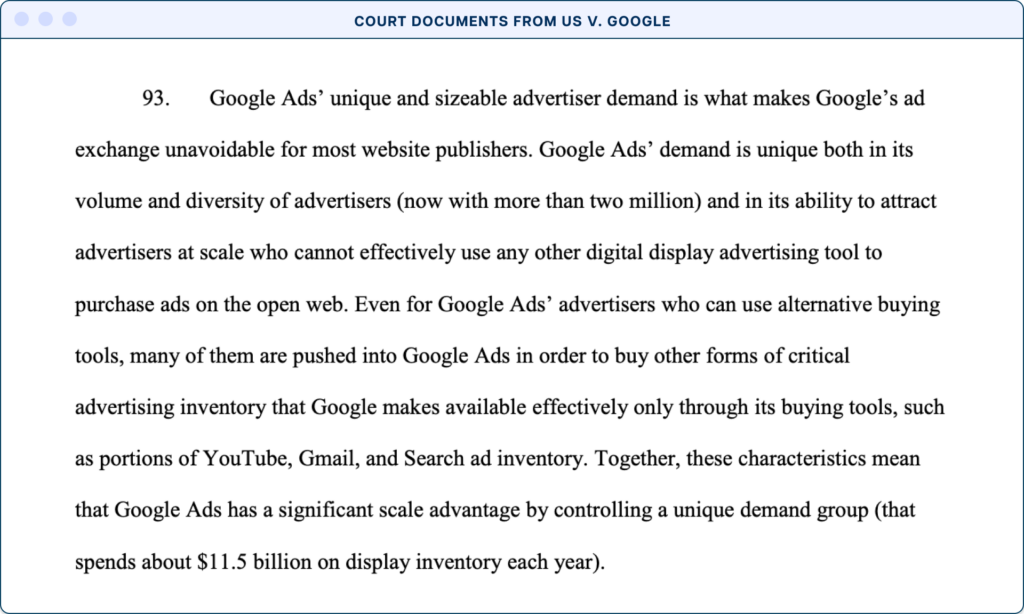
The takeaway is this: whether it’s the ad networks used by brands small and large, or the DSPs usually used by big names, Google has its fingerprints all over every aspect of the buy side — aka the demand side — of ad transactions.
Why don’t advertisers know what they buy?
Because Google controls so much of this industry, most brands end up working with them — especially their ad network. This is despite the fact that after they give money to an ad network, brands usually have no way to verify their advertisement is showing up in the promised end destination.
That’s why we find, say, the Church of Jesus Christ Latter-day Saints advertising on a porn website, or the U.S. Mint advertising on an Iranian website that’s likely sanctioned.
So Google’s dominance allows it to promise advertisers the world, charge what they want, and no one really dares push back on it — because where else would they go? Advertisers, in turn, can proudly show those promised metrics internally.
But the reality is, if they were able to look under the hood, they’d figure out that ads often end up showing up in far less savory places than what was promised to them.
Aside from watchdogs like us, there’s no recourse for brands when their ad shows up on a disinformation site, or next to pornography.
It’s not illegal. It’s not regulated. All they can do is block the website, complain to Google, and move on until the next bad ad placement makes headlines.