


Next month’s Google antitrust trial could change the world.
The outcome could alter what you see online, which websites can profit from the information (or disinformation) they publish, and whether advertisers can actually get a say in where their money goes.
Now that we’ve got your attention, we’d like to help you.
Check My Ads, the only nonprofit adtech watchdog, is launching an explainer series where we’ll be breaking down Google’s role in the adtech industry: what it does, what it controls, and how it affects, well, everything.
We’re going to spend the next few weeks making sure you’ve got all the tools you need so that, when the Department of Justice’s massive antitrust trial gets under way in four weeks, you’re ready for it.
And guess what, you lucky duck! You just clicked on the first part of this series: an overview of the issue.
Wait…Google is an ad business?
Most of us know Google as the place we plug in our questions about everything from what Elon Musk looked like before fame (sorry) to why the sky is blue (blue light scatters more to whether your favourite celebrity is actually a nepo baby (probably).
But in reality, Google doesn’t make most of its money that way. Alphabet, which is basically Google’s holding company, generated $147 billion in revenue in 2020 — and 80 per cent of that revenue came from ads.
Google makes most of its money from its ads business — and, more importantly, the most money in the ad business is made by Google.
Hey Google, what’s a monopoly?
The days of a company calling a local newspaper and buying a specific ad placement are all but gone.
Instead, advertisers or their agencies fork money over to an ad network. That ad network makes promises (usually with no way for the advertiser to verify it made good on said promise) and then kicks the funds down an opaque pipeline of automated auctions in the blink of an eye until an ad pops up on your screen.
In 2023, Google commanded the largest share of this digital advertising revenue worldwide: around 39 per cent. For context, Facebook held the next largest chunk (18%), followed by Amazon (7%) and TikTok (3%).
To truly understand how Google influences every aspect of online advertising, we need to explain how it’s made of three main parts:
- The sell-side, which is the websites themselves selling “inventory,” or ad space. Think of a slot for a banner ad, or a place for a clip to play before a video.
- The buy-side, which is the advertisers placing bids on that ad space. This is where the demand for advertising space is.
- The exchange, which is the automated auction house that connects buyers and sellers, where bids are placed and accepted. When an advertiser, or the company representing them, wins an auction, you’ll see their ad. Think of it like the stock market; but instead of gaining shares, advertisers gain eyeballs.

Notice something about the chart above? Google has about 40% to 90% of the market share in every step of online advertising, according to the Department of Justice.
Google controls 90% of the market share of the sell side, anywhere between 40-80% of the market share of the buy side, and about 50% of the market share of the step that connects those sides together — the ad exchange.
Those are the kinds of numbers that could make someone think you’ve got a monopoly — especially when you couple them with the DOJ’s assertion that Google has been squashing potential rivals through acquisitions and has used this dominance to “force” publishers and advertisers to use its products, while keeping more and more of the money for themselves.
That’s the essence of the case the DOJ laid out in announcing the antitrust case in January, 2023.
The trial itself is set to kick off on Sept. 9 — and its outcome could topple Google’s dominance of one of the biggest economic engines of the internet.
Okay, but why should I care?
Digital advertising is the business model of the internet.
Because Google controls so much of the digital ad industry, it basically holds the fate of publishers, of journalism, in its hands. If a newspaper wants to put ads on its website, it’s more than likely dealing with Google, its policies, and the rates it sets — with very little choice. This tension carries through to other methods news organizations use to be sustainable. Google itself calls paywalls “threats to the open web” in a strategy document, as Jason Kint, the CEO of Digital Content Next, pointed out.

It also controls the measurement tools that help determine ad prices, and the ones that collect user data along the way.

Google also decides what the rules are, and when and how to enforce them. Advertisers aren’t often buying a specific ad space directly from a website, so instead, that advertiser has to trust that Google will reach the people they want to reach, and won’t put its brand name somewhere it doesn’t want to be, like websites that incite hatred or that discriminate, that make unreliable and harmful claims, or that contain sexually explicit content, for example.
But here’s the thing: when advertisers have no choice but to use your services, why bother taking the costly, resource-intensive step of actually making sure the stuff you’re monetizing adheres to your policies, and why keep your promises instead of sending money to wherever it’s most profitable for you? It’s not like advertisers will stop using Google. The same goes for publishers who basically have no choice in how much Google sends their way or keeps for themselves.
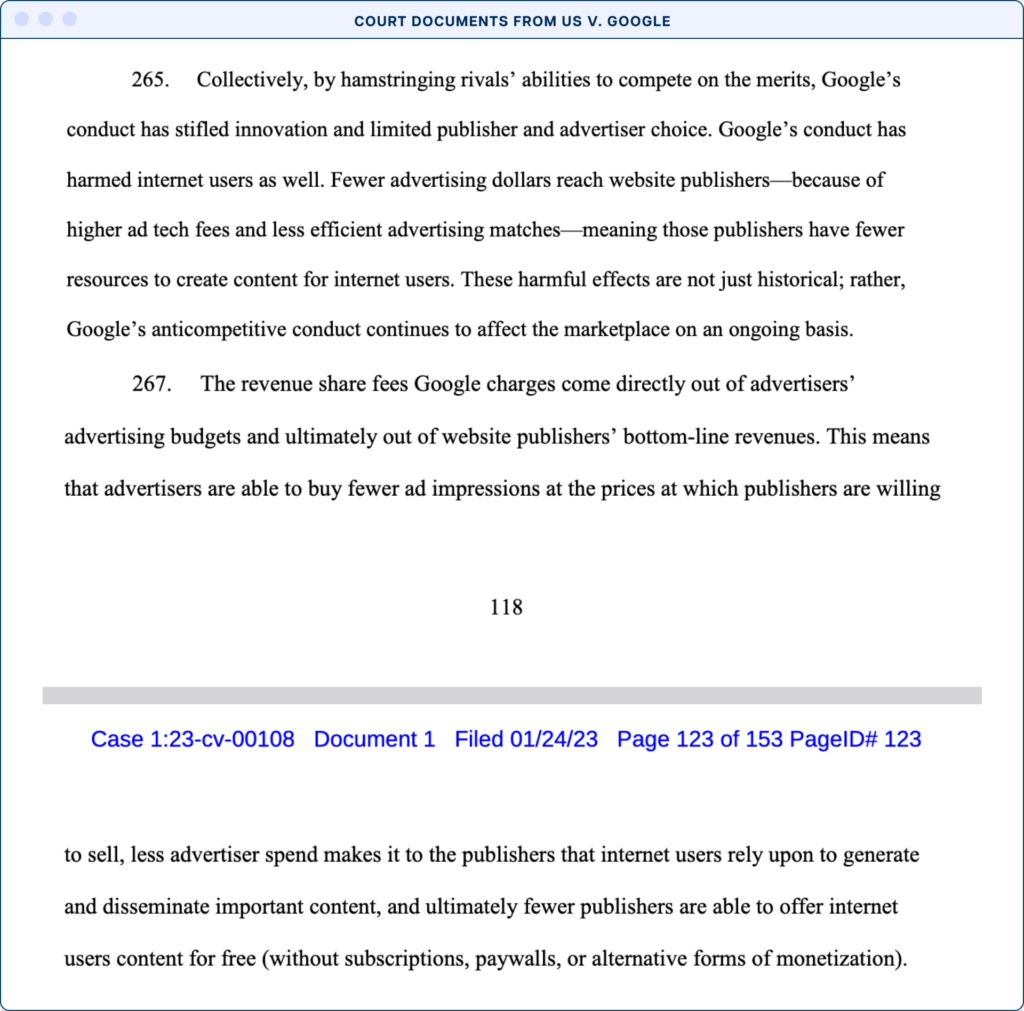
That’s probably why we keep finding Google’s fingerprints all over ads on websites that violate its own policies by spreading disinformation or hate, host pornography, and much more. And every ad dollar that goes to an unscrupulous site is one fewer that finds its way to legitimate publishers, like news websites, adding to the proliferation of misinformation.
Google doesn’t have to do anything about this — and in the meantime, disinformation and hate websites pocket the profits. No competition means no consequences.
But this DOJ case has the power to change all of that. It has the power to break up this monopoly and force Google to stop exploiting publishers, and not to take advertisers for granted.
And if advertisers can actually choose where their money goes, well, that could change the world.
That’s why we’ll be on the ground covering this landmark trial in September. And, since Google is hard at work using their influence network to downplay the importance of this trial so their shareholders don’t worry, and trying to keep eyes off any unflattering information they’d rather you not see, we launched a website to help all of you follow along, every step of the way. Visit www.USvGoogleAds.com to stay informed.